
Plant record · Tree · Cupressaceae
Is American Arborvitae (Thuja, Emerald Green) deer resistant?
Thuja occidentalis
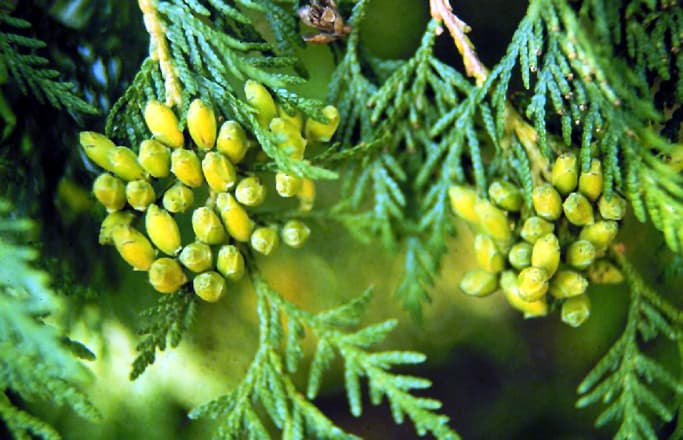
No. Deer will destroy this. Do not plant it unprotected.
- Type
- Tree
- Hardiness
- Zones 3–7
- Light
- Part shade
- Height
- 480–720 in
- Maintenance
- Low
- Native range
- 23 US states
- Family
- Cupressaceae
Damage steps follow a published university field scale. How plants are rated.
About American Arborvitae
Browsed to a distinct line as high as a deer can reach, and a leading cause of ruined privacy screens.
This is the damage that does not recover. Arborvitae will not resprout from bare wood, so once the lower three or four feet have been stripped the plant stays bare there permanently. A hedge planted for screening ends up screening nothing below head height, which is exactly where it was needed.
Do not plant it unprotected in deer country. If it is already in and being browsed, netting or fencing through the winter is the only thing that stops it, because winter is when the damage happens.
Green Giant is often sold as the deer-resistant alternative. It is browsed noticeably less than American arborvitae but it is not immune, and under real pressure it will still take a browse line.
Do deer eat arborvitae?
Yes, and it is the worst-rated conifer on the Rutgers list. American arborvitae is Frequently Severely Damaged, the bottom tier, "American Arborvitae, Thuja occidentalis, Trees, D," in the company of hostas and yews. NC State: "Damage from deer browsing can be a serious problem," and the same entry records that white-tailed deer "both feed on the branches and use them for shelter from the cold," which is the whole problem in a sentence. The hedge planted for winter screening is where deer spend the winter. The damage is done from November to March, at the height a deer can reach, and it is a browse line rather than a nibble.
Which arborvitae is deer resistant?
None of them, on the evidence, but they are not equal. Rutgers rates Western arborvitae, Thuja plicata, one tier better, Occasionally Severely Damaged, and Green Giant is a hybrid of T. plicata and T. standishii. Nothing consulted here rates the hybrid on its own, so the claim that Green Giant is deer-resistant rests on one parent's C rather than on a trial of Green Giant. One tier better than the worst is still a plant that gets browsed.
Protecting arborvitae
A screen that matters gets a fence or a wrap for the winter, every winter, and over the years the arithmetic favors the fence: in the VerCauteren trials a 1.5 meter fence stopped none of the deer, 2.1 meters stopped 85 percent and 2.4 meters, about 8 feet, all of them. Burlap or netting on a frame from November to April does the same for a young hedge one season at a time. Repellent works on a small planting: Colorado State's 20 percent egg spray is rated High, reapplied at about thirty days, which through a winter means five applications in weather that does not encourage it.
If it is browsed
This is the plant where recovery depends on something hard to see. Iowa State's answer to whether stripped arborvitae green back up: "If buds are present, the lower branches will produce new growth in spring. The new growth should be apparent by early summer." And the other case: "The lower portions of the arborvitae will remain bare and likely never develop new growth if no buds are present." A hedge that has reached the second case is replaced, or underplanted with an evergreen deer leave alone, Japanese plum yew being one that gives the same mass in shade.
Protecting American Arborvitae
Deer will destroy this without protection, so the question is which kind you are willing to pay for.
- 1Protecting a young treeBrowsing costs a season. A buck rubbing a two-inch stem in October girdles it and kills it outright.
- 2How tall a deer fence needs to beEight feet, and six is the most common expensive mistake in deer fencing.
- 3What a deer fence costsMaterial ratios are stable even when prices are not, and installation reliably doubles the figure.
- 4Repellent that actually worksThe egg-based recipe that reproduces the active ingredient in the commercial sprays that win university trials.
What to plant instead of American Arborvitae
Same plant type, hardy in the same zones, and rated better for deer. If American Arborvitae keeps getting eaten, these go in the same spot.
- Common HackberryCeltis occidentalisZones 3–9Seldom damaged
- Ponderosa PinePinus ponderosaZones 3–7Seldom damaged
- Red MapleAcer rubrumZones 2–9Seldom damaged
- ShadbushAmelanchier canadensisZones 3–8Seldom damaged
- Striped MapleAcer pensylvanicumZones 3–7Seldom damaged
- Yellow BirchBetula alleghaniensisZones 3–7Seldom damaged
Soil and care
- Soil pH
- 6 to 8
- Drainage
- Consistently moist
- Water
- Moderate
- Fertility
- Moderate
- Spacing
- 35 to 71 in apart
- Growth rate
- Moderate
- Maintenance
- Low
Tolerances and uses
- Drought
- Low
- Salt
- Low
- Pollinators
- None
Evergreen
Where American Arborvitae grows
Hardy across 48 states on zone range alone, and native to 23 of them. Mountain and coastal areas sit outside the ranges used here, so check your own zone before ordering. Select any state, including one it will not grow in, for what is resistant there.
Choose a state from the listeasier on a phone
- Pennsylvania
- New Jersey
- New York
- Connecticut
- Massachusetts
- Virginia
- Maryland
- Michigan
- Wisconsin
- Ohio
- Indiana
- Illinois
- Minnesota
- Missouri
- North Carolina
- Tennessee
- Georgia
- Texas
- Colorado
- California
- Oregon
- Washington
- New Hampshire
- Vermont
- Maine
- Rhode Island
- Delaware
- West Virginia
- Kentucky
- South Carolina
- Florida
- Alabama
- Mississippi
- Louisiana
- Arkansas
- Oklahoma
- Kansas
- Nebraska
- Iowa
- North Dakota
- South Dakota
- Montana
- Wyoming
- Idaho
- Utah
- Nevada
- Arizona
- New Mexico
- Alaska
- District of Columbia
- Hawaii
Common questions about American Arborvitae
- Is American Arborvitae deer resistant?
- American Arborvitae (Thuja occidentalis) is rated Frequently Severely Damaged, step 4 of 4 on the damage scale this site uses. Deer will destroy this. Do not plant it unprotected.
- What hardiness zones does American Arborvitae grow in?
- American Arborvitae is hardy in USDA zones 3 to 7. Outside that range it will either not survive winter or will struggle with summer heat.
- Does American Arborvitae grow in shade?
- Yes. American Arborvitae tolerates part shade, which makes it one of the options for a shaded bed where deer also browse.
- How big does American Arborvitae get?
- Mature height is roughly 480–720 in. Growth rate is moderate.
Browse from here
Every list American Arborvitae belongs to.
All trees·Deer favorites·Part shade plants·Mast and fruit trees·Evergreen shrubs