
Plant record · Perennial · Lamiaceae
Is Russian Sage deer resistant?
Salvia yangii
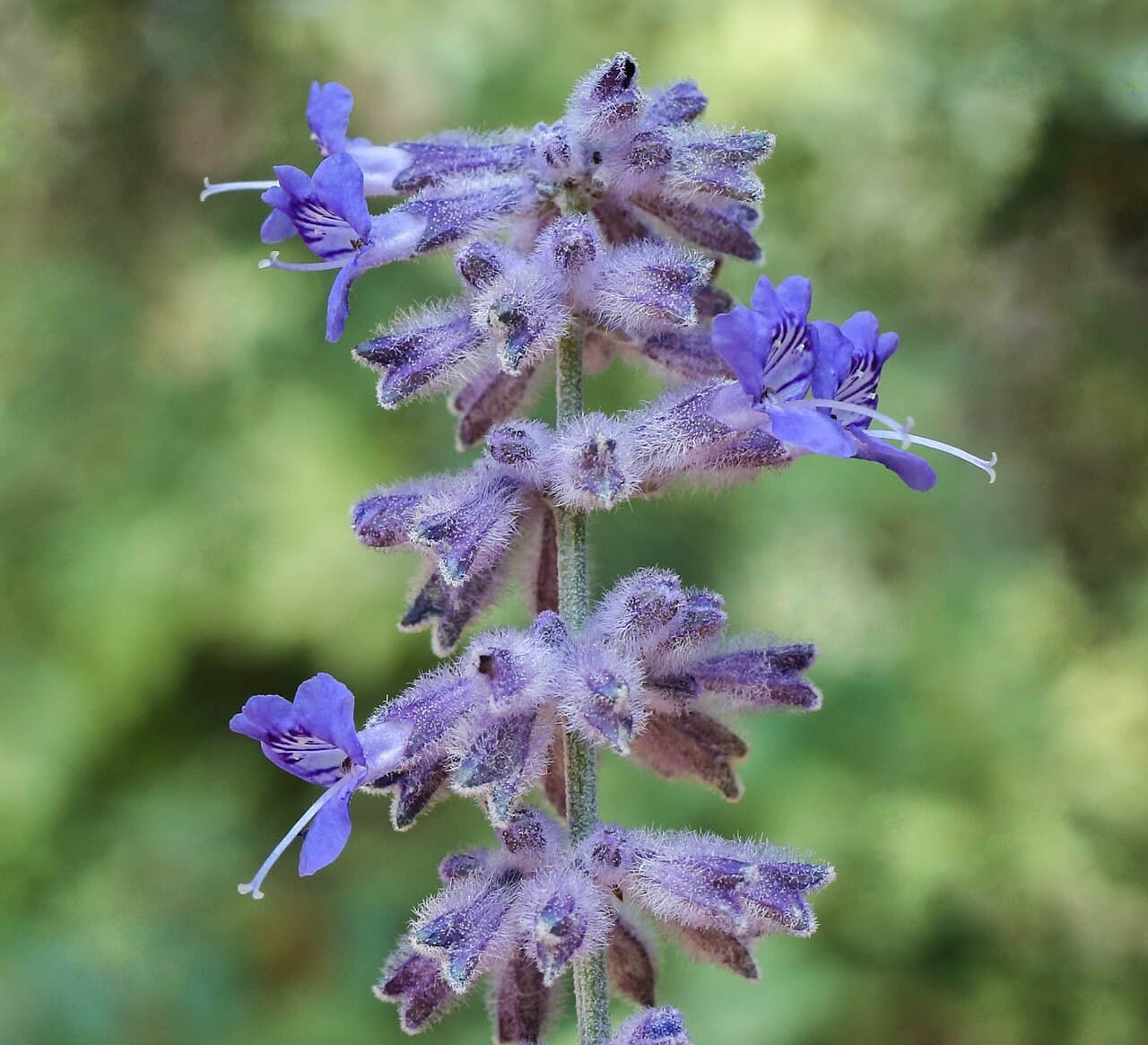
Yes. Deer almost always leave this alone.
- Type
- Perennial
- Hardiness
- Zones 5–9
- Light
- Full sun
- Height
- 24–48 in
- Bloom
- July–October
- Maintenance
- Low
- Family
- Lamiaceae
Damage steps follow a published university field scale. How plants are rated.
About Russian Sage
Aromatic silver foliage that deer walk past even in bad years, and one of the few plants that looks better in poor dry ground than in good soil.
Fed and watered, it grows tall, soft and floppy, then splits open in the middle after rain and never recovers its shape. Sharp drainage, full sun and no fertilizer is the whole requirement.
Cut it hard in spring, down to about six inches, once you see buds breaking on the lower stems. Leaving the old growth up over winter is fine and looks good in frost, but pruning in fall risks losing the plant. Note that botanists moved it out of Perovskia into Salvia, so newer labels read Salvia yangii.
Do deer eat Russian sage?
Rarely. Rutgers rates it Rarely Damaged, A, listed under its old name Perovskia, and NC State tags it deer and rabbit resistant with drought, poor soil, pollution and salt on the same list. It sits with lavender and catmint among the aromatic gray-leaved perennials that a deer walks past in a bad year, and the scent that carries across a bed in August is the reason.
Where it grows
NC State: zones 5a to 9b, 2 to 4 feet, full sun, flowering June to October, and "Russian sage has no serious insect or disease problems." The one problem NC State records is the one the note above describes: it "may sprawl or flop over as the growing season progresses," which is what rich soil and water do to it.
Protecting Russian sage
Nothing. It is the plant other things are protected by, in the sense the perennials page describes: a drift of it in front of the phlox does measurable work because the deer meets the scent first.
If it is browsed
It regrows from the woody base, which is where it is cut to every spring anyway; a browsed Russian sage is a pruned one. Late flowers come on the new growth.
Soil and care
- Soil pH
- 6 to 8
- Drainage
- Sharp, gritty. Will rot in wet soil
- Water
- Low
- Fertility
- Low
- Spacing
- 24 to 35 in apart
- Growth rate
- Fast
- Maintenance
- Low
Tolerances and uses
- Drought
- High
- Salt
- High
- Pollinators
- High
Coastal sites
What to plant it with
- Lambs Ear
Both silver, both drought-hardy, both need the same sharp drainage.
Keep apart from
- Impatiens
Full sun and drought against wet shade. Nothing about these two overlaps.
Similar to Russian Sage
Other perennials with the same deer rating.
- Anise HyssopAgastache sp.Zones 4–9, genus rangeRarely damaged
- Basket of GoldAurinia saxatilisZones 3–7Rarely damaged
- Bearded IrisIris germanicaZones 3–9Rarely damaged
- Bigleaf GoldenrayLigularia dentataZones 4–8Rarely damaged
- Bleeding HeartLamprocapnos spectabilisZones 3–9Rarely damaged
- Butter and EggsLinaria vulgarisZones 3–9Rarely damaged
Where Russian Sage is used
3 guides on this site plant it, and say where and what beside it.
- Deer-Resistant Rose Garden PlanNo rose is deer resistant, and rugosa rates no better than a hybrid tea. So the plan is an enclosure you can live with looking at.6 min
- Mailbox Garden PlanFull sun, no water, road salt and total deer exposure. Plants that survive all four.4 min
- Wall and Foundation Planting PlanThe strip at the base of a wall is the driest ground you own, and a wall stops nothing. Aspect decides the planting; the rain shadow decides whether it lives.6 min
Where Russian Sage grows
Hardy across 50 states on zone range alone. Mountain and coastal areas sit outside the ranges used here, so check your own zone before ordering. Select any state, including one it will not grow in, for what is resistant there.
Choose a state from the listeasier on a phone
- Pennsylvania
- New Jersey
- New York
- Connecticut
- Massachusetts
- Virginia
- Maryland
- Michigan
- Wisconsin
- Ohio
- Indiana
- Illinois
- Minnesota
- Missouri
- North Carolina
- Tennessee
- Georgia
- Texas
- Colorado
- California
- Oregon
- Washington
- New Hampshire
- Vermont
- Maine
- Rhode Island
- Delaware
- West Virginia
- Kentucky
- South Carolina
- Florida
- Alabama
- Mississippi
- Louisiana
- Arkansas
- Oklahoma
- Kansas
- Nebraska
- Iowa
- North Dakota
- South Dakota
- Montana
- Wyoming
- Idaho
- Utah
- Nevada
- Arizona
- New Mexico
- Alaska
- District of Columbia
- Hawaii
Common questions about Russian Sage
- Is Russian Sage deer resistant?
- Russian Sage (Salvia yangii) is rated Rarely Damaged, step 1 of 4 on the damage scale this site uses. Deer almost always leave this alone.
- What hardiness zones does Russian Sage grow in?
- Russian Sage is hardy in USDA zones 5 to 9. Outside that range it will either not survive winter or will struggle with summer heat.
- Does Russian Sage grow in shade?
- No. Russian Sage wants full sun and will grow thin and flop in shade.
- How big does Russian Sage get?
- Mature height is roughly 24–48 in. Growth rate is fast.
- When does Russian Sage bloom?
- Russian Sage flowers from July–October.
Browse from here
Every list Russian Sage belongs to.
All perennials·Rarely damaged·Full sun plants